


Centre pipe

One of the key internal components of modern reforming reactors is the centre pipe. This device distributes feedstock flows, removes products or supplies coolant to the active zone. The design improves mass-transfer efficiency and temperature-field uniformity.
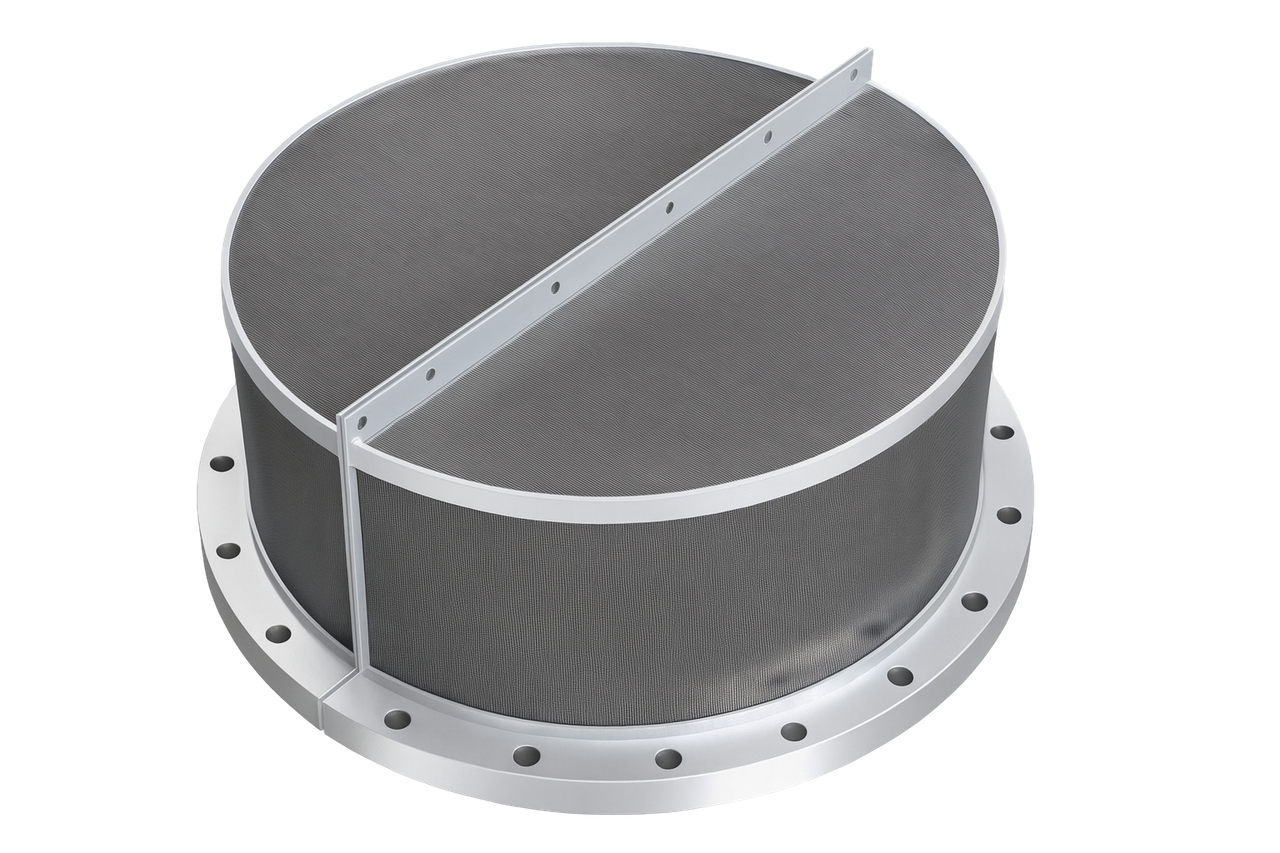
The reactor centre pipe is a perforated pipe with a slotted screen (filter) secured by welded joints. It is used to collect reaction products and retain the catalyst in the reaction zone.We offer an integrated service for the supply of reactor internals. Learn more at the link
Fields of Application
Advantages


Do you have any questions?
Functional purpose of the centre pipe in a reactor
The reactor centre pipe is a perforated or slotted structure installed along the vessel axis. Its primary purpose is to control phase movement within the shell. In fixed-bed catalytic reactors, the pipe serves as a collector for the finished product after it has passed through the bed, or uniformly supplies carrier gas. Its axial position ensures minimal hydraulic resistance and maximum unit capacity. The centre pipe is an important part of the active zone where the main reactions occur.
Depending on the process, the centre pipe may operate as a flow outlet or inlet. At high pressures and temperatures, the structure must retain its rigidity and leak-tightness. The Spliteks plant in Serpukhov manufactures reactor centre pipes up to 2.5 m in diameter and 15 m long, meeting the requirements of modern industrial reactors.
Design features and materials
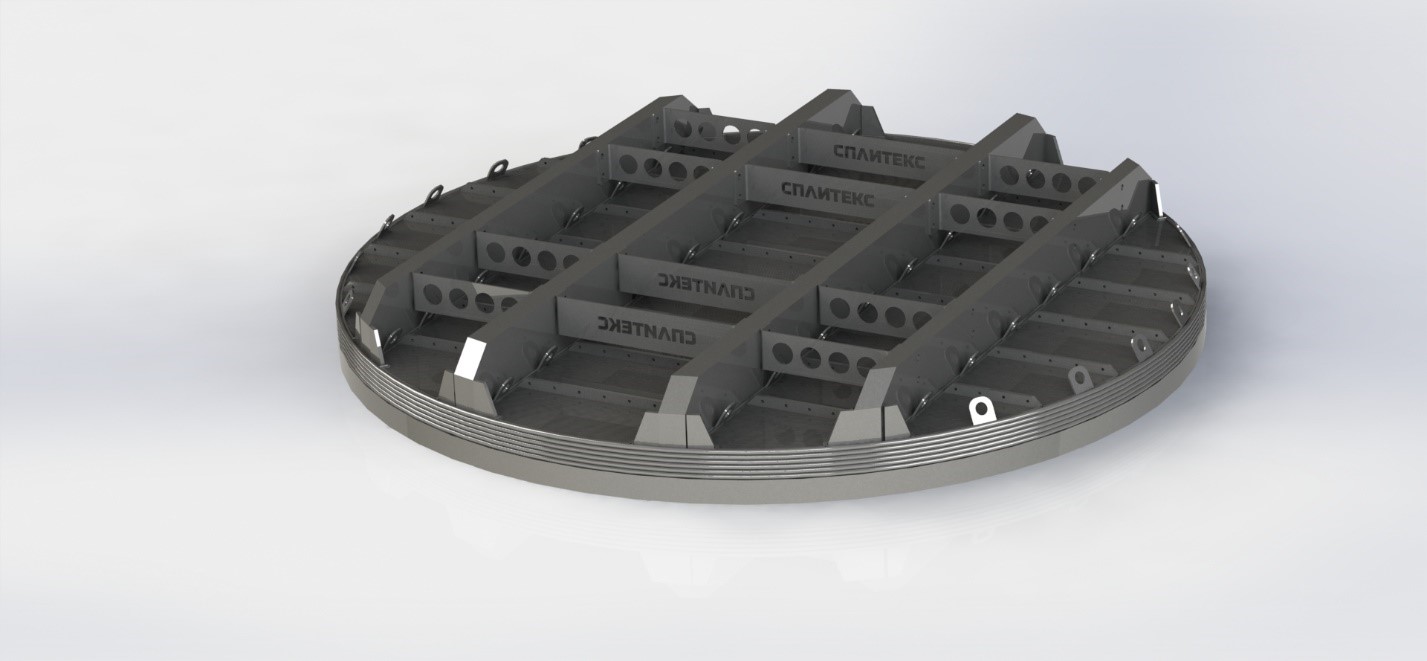
The reactor centre-pipe design comprises a load-bearing perforated shell, internal spacer rings, flanged connections to the vessel and, where required, guide vanes. Chrome-molybdenum-vanadium steels (12Kh1MF and 15Kh5M) or austenitic stainless alloys (08Kh18N10T and 316L) are used. Each component undergoes incoming inspection and post-weld heat treatment. The device is attached to the upper or lower reactor nozzle, forming a single circulation circuit. The design service life is at least 20 years.
The following parameters are taken into account when manufacturing a reactor centre pipe:
-
Uniform perforation: hole spacing is calculated using CFD modelling.
-
Thermal stability: absence of deformation under cyclic loads.
-
Resistance to corrosion in hydrogen sulphide- and chloride-containing environments.
-
Geometric accuracy to provide the required clearances from the internal heat shields.
Sulzer reactor centre pipe: continuity of technology
Historically, the Sulzer reactor centre-pipe design was developed by the Swiss group for hydrotreating and reforming units. Following the withdrawal of foreign suppliers, Russian companies faced the need to localise production. As the successor to Sulzer Chemtech, Spliteks has fully reproduced and improved the design documentation, including that for the reactor centre pipe. Today, the products are manufactured in accordance with Russian standards (GOST standards and safety rules) and successfully replace imported equivalents at oil refineries and gas processing plants. Spliteks is the only legitimate supplier with a complete engineering knowledge base and many years of manufacturing experience.
Every reactor centre pipe undergoes mandatory testing on a rig simulating actual conditions: pressure up to 25 MPa, temperature up to 550°C and flow rate up to 2,000 m³/h. The tests confirm uniform flow distribution across the cross-section, with deviations not exceeding 5%. The design incorporates differential temperature and pressure sensors for connection to automatic control systems.
Features of installation and integration into the process line
The reactor centre pipe is supplied in sections up to 6 m long for ease of transportation. On-site assembly is carried out using flanged joints with alignment checks. Sliding supports and expansion bellows are provided to allow the pipe to expand freely relative to the shell. Connection to external pipelines is made through nozzles extending from the reactor bottom head or cover. All welds undergo 100% radiographic inspection.
After the centre pipe has been installed, hydraulic strength and leak-tightness tests are performed. The company’s specialists prepare the equipment data sheet and a certificate of conformity with Technical Regulation of the Customs Union TR CU 032/2013. For operating plants, the pipe can be replaced through the manway at the top of the reactor without completely unloading the catalyst.